Updated Dec. 31, 2025:
You should’ve received an email from me (Jo Votolato) with the status of your abstract. If you have NOT yet received an email, please contact me ASAP at [email protected]. Happy New Year!
Submission Deadline *Extended*:
December 4, 2025
8:59pm PST/11:59pm EST
Important notes:
- All presenters of accepted abstracts will be offered a reduced registration fee.
- Honoraria, accommodation, travel, and other associated expenses are not covered by the conference.
- Presenters must be comfortable presenting and answering questions in English.
- Presenters should presuppose prior knowledge of FASD by attendees.
- If your abstract is accepted, for the conference syllabus, you will be asked to select either: (1) the abstract; or (2) a summary of your presentation and/or a PDF of your slides or other illustrative materials.
- Presenters should reflect on the conference goals, learning objectives, and target audience.
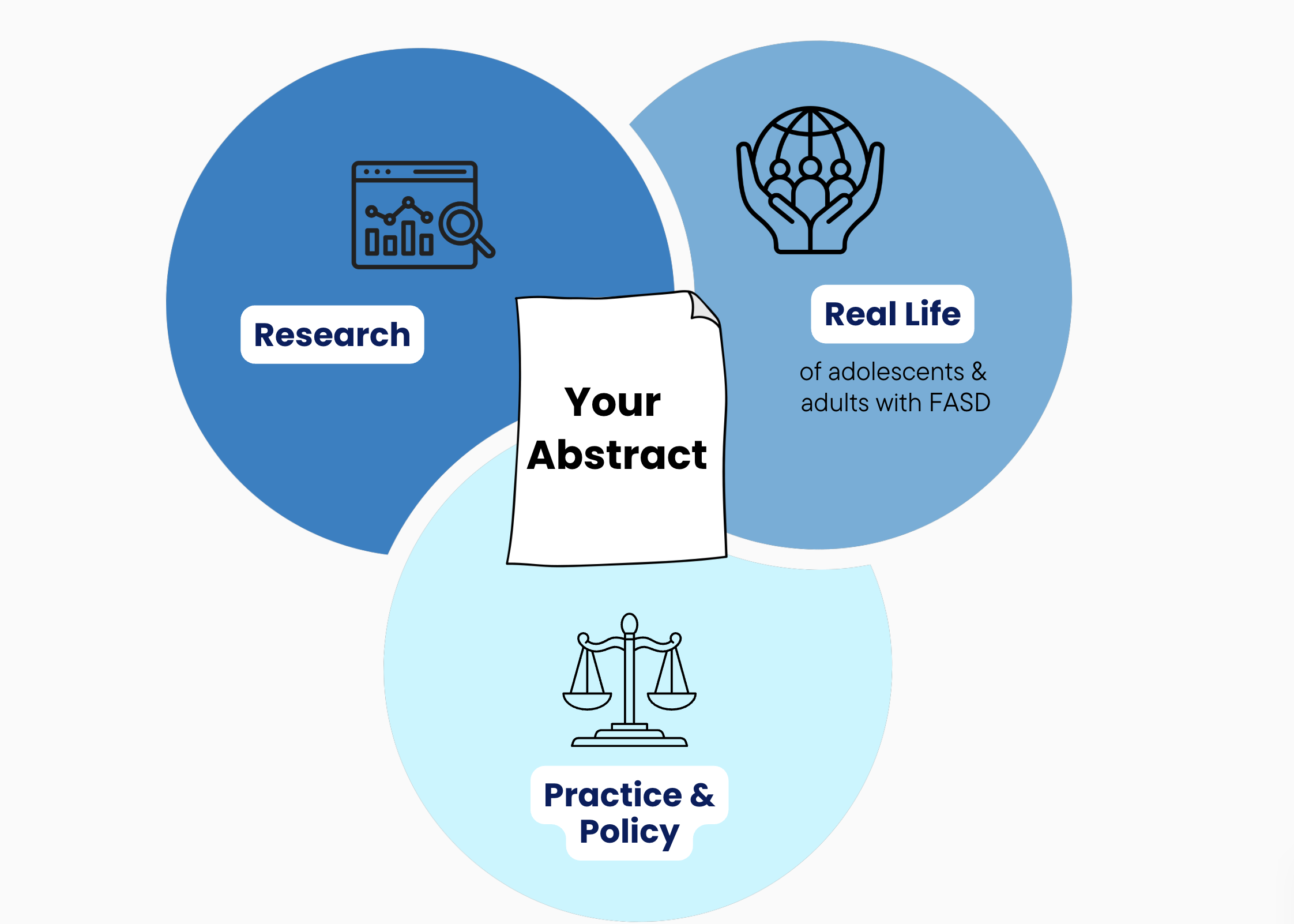
- When preparing your abstract, please reflect on these guiding questions: How does your work matter to the daily lives of people with FASD and their families? What impact could your findings have for the wider community, including service providers, policymakers, and advocates? How will your research or project help improve support, understanding, or prevention in a way that respects families and avoids stigma? How are the voices of people with FASD, their families, or community programs included or strengthened in your work?
- In addition to the quality of the abstract itself, priority will be given to submissions that:
- address a variety of topics from a variety of presenters
- highlight translational research
- feature work led by early-career investigators

Before submitting, please review the required information (#1-7 below).
If you have any questions, please contact Jo Votolato: [email protected].
1. Abstract title
2. Preferred Format
Indicate the preferred format under which your abstract is submitted:
- Pre-conference 3-hour half-day interactive session (minimum of 2 presenters)
- Pre-conference 6-hour full day interactive session (minimum of 2 presenters)
- PLENARY (1-2 presenters; 45 minutes): A plenary session is to be attended by all participants. Therefore, the presenter(s) should be mindful of presenting to a diverse audience, many of whom will have only a basic understanding of the topic.
- *60-MINUTE BREAKOUT SESSION (minimum of 2 presenters)
- *90-MINUTE BREAKOUT SESSION (minimum of 3 presenters)
- 15-MINUTE ORAL PAPER (1-2 presenters only): Oral papers should be succinct presentations of innovative projects or research and will be grouped together by the conference committee into similar topic areas.
- 5-MINUTE LIGHTNING TALK (1 presenter only): Maximum of 2 slides. Consider this to be a trailer to prompt the audience to interact with you for further discussion.
- Posters will be displayed for the duration of the conference and will have designated poster viewing times, including a poster networking reception. Poster board size is 45” x 45” (115cm x 115cm), so all materials must fit within this space.)
*If you are submitting a pre-conference, 60-min or 90-min session, please provide a brief 50-word description of your session to be inserted into the program brochure if your abstract is accepted for presentation as delegates must choose to attend parallel sessions.
3. Themes
Indicate 1-3 theme(s) that which best fit your presentation:
- Addictions
- Biomedical
- Community/Family
- Cultural
- Diagnosis/Screening/Assessment
- Economics
- Education
- Employment
- Ethics/Social Justice
- Etiology
- Indigenous
- Intervention/Support
- Justice/Legal
- Physical and Mental Health
- Policy
- Prevention
- Services
- Women
- Other: please specify
4. Authors and Presenters
List all authors and presenters. Include their affiliations (Title, Name, Suffix, Profession, Department/Organization, City, State, Country) as well as their email addresses. Provide brief, 50-word (max.) biographies for each presenter, which will be used to introduce the presenter on-site at the conference (you will be able to update this later if needed).
5. Presentation Summary
Provide a presentation summary (500 words max.) with applicable headings: background/objectives, methods, results, discussion/conclusion.
6. Learning Objectives
Provide 2-3 learning objectives (must be learner-oriented),
7. Relevance of findings
Provide relevance of findings for 1) the broader field of FASD (e.g., providers, policymakers, and communities) 2) benefiting of individuals and families living with FASD or the prevention of FASD in a way that does not further stigmatize families. Both answers must use plain language, understandable by a general, lay audience.
8. Format Change Preference
The conference program committee may prefer to switch the format of your presentation from your preferred format. Indicate whether you are open to this option.
9. (If Applicable)
National Institute on Alcohol Abuse
and Alcoholism (NIAAA)
We are excited to announce that the National Institute on Alcohol Abuse and Alcoholism (NIAAA) has funded a conference grant, 5R13AA028176-05, to assist a limited number of individuals with partial travel support to present at the 10th International Conference on Adolescents and Adults with FASD in April 2026.
If you and/or your co-presenter(s) are a junior investigator (≤10 years within your doctoral degree), we invite you to apply for a partial travel support and complimentary registration. To apply, please visit the link below.

Once you have submitted your abstract, the submitter will receive an automatic email confirming receipt, which will include options to edit your abstract until the portal closes end of day December 4. If you don’t receive an email after 24 hours, or if you have questions before submission, please contact Jo Votolato, Conference Director, FASD United at [email protected].
Ready to submit?
Funding for this conference was made possible (in part) by 5R13AA028176-05 from the National Institute on Alcohol Abuse and Alcoholism (NIAAA). The views expressed in written conference materials or publications and by speakers and moderators do not necessarily reflect the official policies of the Department of Health and Human Services; nor does mention by trade names, commercial practices, or organizations imply endorsement by the
U.S. Government.