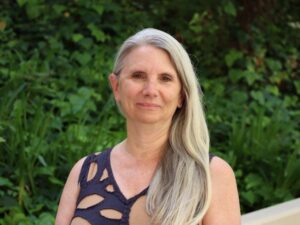
Dr. Sarah Mattson is a leading researcher in the Collaborative Initiative on Fetal Alcohol Spectrum Disorders (CIFASD) with a deep passion for understanding FASD and how the brain impacts behavior. Dr. Mattson’s current focus is on developing new screening tools that are more accessible to families and professionals, including BRAIN-online, an evidence-based screening tool for FASD that can be taken at home.
Years before Dr. Sarah Mattson would establish her career as a renowned FASD researcher and be instrumental in the founding of CIFASD, she found herself sitting in a freshman college classroom taking Introductory Psychology. As a biology major, Sarah took the psychology class as an elective; little did she know that it would change her academic and career focus. At the head of the room stood Dr. Edward Riley. While he would go on to found and lead CIFASD, Dr. Riley at the time was going over the basics of psychological principals and behavior. He also described FASD and its significant features. Sarah had not heard about the condition before and was immediately fascinated. “I did well in the class,” she told me. I recently had the pleasure of talking with Dr. Sarah Mattson, now one of the leading lights of CIFASD, a multidisciplinary research consortium and a powerful force for progress in the FASD community. We talked about her work and career in FASD research, going back to that college classroom.
As her college psychology class concluded, Dr. Ed Riley asked Sarah if she would consider joining him to work in his lab. “No thank you,” Sarah responded at first, before later changing her mind, setting off on the course that would define her career and lead directly to countless research breakthroughs that families with FASD continue to benefit from every day.
An early passion for FASD and for research
As a college sophomore, Sarah Mattson started working for Dr. Ed Riley. She recalled to me fondly that she still has the handwritten letter that she wrote to Ed asking if she could please reconsider working in the lab. “When I started in the lab investigating prenatal alcohol exposure, I got really interested in FASD, but I also fell in love with the idea of research itself, the process of investigating a question,” Sarah says. When Ed Riley took a job at San Diego State University, Sarah made the decision to make the move to California from New York. “That was a big deal for me, and I started a doctoral program in San Diego and Ed and I worked together doing clinical research.” Sarah lit up describing those early years. “It was such a great time, I got to meet Dr. Ken Jones, who coined the term fetal alcohol syndrome, and other experts. I got to develop an interdisciplinary research program on prenatal alcohol exposure . I kept getting these unique opportunities, it was really awesome.”
As she was learning more and more about FASD, Sarah Mattson focused her studies on the area of neuropsychology, conducting neuropsychological assessments of children with PAE. This led her to work on the very first brain imaging studies done in FASD, still as a graduate student. “I felt so passionate about understanding the effects that PAE has on brain development, how it affects cognition and brain structure,” Sarah told me. Over time, she became more interested in the everyday effects of PAE, looking at the particular ways in which a person with FASD experiences school and their everyday living experience. The goal for Sarah was to get a better handle on understanding the cognition and behavior of people with FASD.
Over time, Sarah’s area of focus shifted towards ways to improve the identification of FASD. “I like to say that FASD is the most common neurodevelopmental disorder that most people don’t know anything about,” Sarah says. “It’s one of the most common, if not the most common, neurodevelopmental disorder, yet is so underrecognized and just not apparent to most people. It’s been my passion over the last decade to improve our understanding of FASD among the public and improving diagnosis and identification so that we can get to a point where 80% of children with FASD are no longer being missed.”
CIFASD beginnings, recognizing the importance of neuropsychology
Before Sarah developed a series of FASD screening and identification tools through CIFASD-supported research, she worked to get CIFASD off the ground. What grew into CIFASD took root with Sarah, Ed Riley, and a small group of FASD experts from around the world gathering at a chateau in France for a lively meeting. Sarah recalled that with the help of the National Institute on Alcohol Abuse and Alcoholism (NIAAA), Ed Riley created an international FASD collaboration. “We started out small with six or seven FASD experts from around the world talking about PAE from different perspectives in the late 1990s,” Sarah says. In 2001, NIAAA funded “an incredible meeting in the south of Spain” which included FASD experts from all over, including the director of NIAAA at the time, Dr. Ting-Kai Li. Sarah describes that meeting as “the genesis of CIFASD.”
“I was pregnant with my daughter when we wrote the first application for CIFASD,” Sarah recalled to me. “My daughter is now 21 years old. I remember I was pregnant with my son when we wrote the second phase of CIFASD and he is now 18. CIFASD has been such an integral part of my professional development. I can’t imagine where I would be if we didn’t have CIFASD.”
“My experience showed me that neuropsychological assessment had to be a major part of this new initiative, and that became my role,” Sarah told me. “I was proud to lead up the neuropsychological aspect of FASD within CIFASD.” Sarah is dedicated to ensuring that the neurobehavioral aspect of FASD stays a key part of CIFASD. “We need to understand how someone with FASD goes about their everyday life, and to know that we have to understand how the brain works.” Over the years, CIFASD has changed and evolved, while remaining consistent in its conviction that it is critical to understand how the brain impacts behavior.
Now in its fifth iteration, CIFASD has kept a focus on the area of neuropsychology since its first iteration in which multiple sites used the same neuropsychological test battery. “We had a set of tests that could be used in any language and we collected data in various countries, including Russia, Finland, South Africa, and the United States, and we all administered the same tests,” Sarah explained. This process served as Sarah’s first sustained exposure to the deeply collaborative environment that CIFASD fostered. “I had done previous work that was multi-disciplinary, but here I was working with people with similar perspectives coming together to coordinate a project that was truly international. It was such a great experience for me.”
International perspectives across multiple sites
One of the most amazing things about CIFASD to Sarah is the multi-site approach. “We are bringing together researchers from all over the world through CIFASD,” Sarah says. “This gives us an incredible perspective because while we meet regularly virtually, we also meet a few times a year in person. These in-person meetings are always really amazing because it allows us to present our research and get questions from outside of our subject area. I love seeing so many people in the same room at the same time who all are interested in FASD, who have the same overall goal. Each one of us has a special and different perspective, which allows us to have these great interdisciplinary interactions that makes us all stronger.”
At CIFASD meetings, clinical researchers hear from basic scientists and discuss topics as varied as microRNAs and cardiovascular disease, which are subject areas that Sarah would not typically encounter in her day-to-day work, but is relevant to the life experience of FASD. “This collaboration leads all of us to have a richer understanding of FASD. I think that may be the best thing about CIFASD, the opportunity to get together with people who have a like mind but completely different perspectives,” Sarah says.
“CIFASD is truly amazing because there are so many different perspectives coming together. Everyone has the same goals, we are all in the FASD arena, but we’re coming at it with very different perspectives,” Sarah says. “We have a prevention project educating women about alcohol use, we have biological researchers looking at zebrafish. My part is understanding the neuropsychological effects of PAE, while others deeply understand other aspects. The synergy of having all these perspectives is invaluable, we just couldn’t do this work any other way.”
The need for new FASD screening tools
As Sarah says, “We know that FASD is very common, and yet most people with an FASD are not identified or even evaluated, which is a serious problem.” Studies show that FASD is indeed highly prevalent, affecting up to 5% of the population, and just a small fraction of these people are ever identified. “We need to improve awareness on the part of the public and professionals, and we also need tools that are more accessible,” Sarah says. As a neuropsychologist, Sarah knows all too well the barriers involved. Neuropsychological assessment is very expensive, time-consuming, and limited by the fact that there are just not that many people who specialize in FASD and can do an FASD-informed assessment.
“Even if you as the parent are very motivated and knowledgeable about FASD, it is hard to find that person for a diagnosis. What we need are professionals to be better educated and we need tools that allow them to do the assessment,” Sarah says. We know from studies that many clinicians just don’t feel comfortable making an FASD-related diagnosis. Traditionally, a diagnosis would require a physical dysmorphological exam from a highly trained specialist, and there are relatively few experts trained in that, underscoring the need for more accessible tools.
Sarah set out to develop screening tools that can be used by families and professionals who may not necessarily be highly trained in FASD diagnosis and has recently conducted studies on two such screening tools: FASD-Tree and BRAIN-online.
BRAIN-online: An accessible tool for FASD screening that works
BRAIN-online is a test of cognition and behavior that can be done at home by people ages 5 and up. The screening tool requires few resources, just an internet-connected computer and is currently available in English, though there is ongoing work to translate the tool into Spanish. As Sarah explains, “If you are interested in using the BRAIN-online tool, you can sign on at the website and take the test. For children, their parents get them started and then the child completes the test. It takes approximately 30-60 minutes to complete. Kids can stop and start if they need to.”
The results so far are very encouraging. “Our latest study shows that with BRAIN-online, we can identify 80% of people who have been affected by PAE,” Sarah says. “80% is a kind of magic number for me because previous studies have shown that 80% of people with FASD are never properly identified. It’s really an amazing finding to turn that same number upside down.” The research is showing that BRAIN-online can be used to identify cognitive effects that are known to be impacted by PAE. “We developed this tool based on decades of experience with neuropsychological assessments,” Sarah says. “We built the screening tool to identify people with FASD and the research shows that it does just that.”
While BRAIN-online is not by itself a diagnostic tool, it provides information that a diagnostician can use to make a formal diagnosis. “You can take the results to a clinician and say that you took this test, tell them if you know there is confirmed PAE, and a clinician can put this together, perhaps with a physical exam, and then make a diagnosis,” Sarah explains. One reason this screening tool is so valuable is that families can take it at home, without the need for special training.
An important potential future application of BRAIN-online is the reduction of wait times for FASD diagnosis, a complex process that can takes months or even years. “Going forward, a clinician could put someone on a shorter list for FASD screening based on the results of BRAIN-online,” Sarah says. “This will hopefully streamline the bottleneck and the long wait time that is often the reality when it comes to FASD diagnosis.”
The immense value of an FASD diagnosis
Sarah Mattson made sure to emphasize the point that it is tremendously valuable to get an accurate FASD diagnosis. “Having a proper diagnosis is important for lots of reasons. From a family’s perspective, a diagnosis provides an understanding into what’s going on with their loved one’s experiences. A diagnosis helps clinicians to identify targets for intervention. There’s a lot of research in interventions for FASD and a lot of great innovative work happening right now in that area. Of course, if you don’t know that a child has an FASD, they won’t be targeted for interventions and treatment that may be very helpful for them.”
With diagnosis and screening, clinicians and families can see the particular ways in which that individual is affected, so it can serve as a guide towards particular types of interventions that a person can most benefit from, such as cognitive interventions or interventions for adaptive skills. The screening results show an individual’s strengths as well as weaknesses, leading to interventions that can improve upon strengths and target the weaknesses that have been identified.
An earlier combination tool for screening: the FASD-Tree
Before BRAIN-online, Sarah Mattson worked on a screening tool called the FASD-Tree. This is the product of combining two related CIFASD studies. Over its history, CIFASD has accumulated a database of hundreds of participants, some of whom have a history of PAE and some do not. “We did two separate studies,” Sarah explains. “One was a decision tree study, and my goal was to come up with four questions that we could use to identify someone with FASD. We got to four domains, rather than four questions: physical measurements, behavior, adaptive functioning, and IQ. The decision tree was effective as a screening tool, though it’s different from BRAIN-online because it requires a physical exam, so it is more limited. This is the work that actually led us to develop BRAIN-online because we needed to have tools that are more accessible and also include measures of cognition.”
In Sarah’s research, she took the decision tree and combined it with another study in which she developed a risk score. “The postnatal risk score worked by combining scores from a physical exam and an adaptive skills test and came up with a score from zero to five with a higher score meaning higher risk of PAE,” Sarah says. “We combined the risk score and the decision tree into one tool and that was the FASD-Tree.” A study found that the results of the FASD-Tree were related to neuropsychological impairments, so a person with a higher risk score was more likely to have challenges with executive functioning. That led Sarah to pivot towards developing a tool that really focuses on cognition and behavior, a path leading directly to BRAIN-online.
Sarah told me that, “The next big goal that I have is to combine these screening tools. I envision a clinician being able to look at the results of BRAIN-online, conduct a physical exam, then based on these results see if a neuropsychological exam is warranted. That way, we can really streamline the whole process of getting a diagnosis.”
Gratitude for a meaningful career making a difference
Sarah Mattson expressed her feelings of gratitude towards FASD United, which she characterized as being “incredibly integral to my work. FASD United has been a great partner to increase the success of brain online.” Sarah talked about her excitement watching a recent video produced by FASD United featuring self-advocate Carl Young speaking about his own experience taking BRAIN-online and then getting a diagnosis. “It was incredible to hear Carl’s story and see a personal perspective and how the BRAIN-online tool really helped him,” Sarah says.
In Seattle at the FASD Research Conference, Sarah met a women who was involved in an FASD clinic in Hawaii and was able to use BRAIN-online to help local families. “That had a big impact on me. When you work in research, of course you hope that your research is helping people. Until somebody actually says “I did this, I used this tool, and it helped me” then you don’t really know that. Those were some amazing experiences,” Sarah says.
“When I first started in research, the first study we ever did had a total of just two participants,” Sarah says. “The most recent study that we are working on has around 800 participants. That growth can really be attributed directly to CIFASD and the strength of its leadership and collaboration. Because we have more research sites and more researchers, and the invaluable support of NIAAA, we’ve been able to really increase the number of participants.” The kinds of studies CIFASD researchers are conducting now would not be possible back in the days in which only had a few people enrolled in the studies. In older studies, Sarah told me that there commonly would be a total of ten people in a given study. “CIFASD really made it possible to have many more people in the studies,” Sarah says.
As Sarah points out, “CIFASD has an incredible breath of experience in our group. We have researchers working on intervention, researchers looking at long-term health effects. I know that there is some really great stuff coming down the pike from CIFASD so I am excited for the future. I am so grateful for all my colleagues and I just want to express that it has been an amazing experience being able to be part of CIFASD from the beginning. I will say this: We have a lot more work to do.”