“This sure is different when it’s me on the hot seat,” Barb Clark told herself as she repeated back a list of 16 items. This was the fourth and final time she was asked to name as many items as she could remember. Again, she caught herself adding a word that she knew wasn’t on the list. This exercise seemed quite simple to Barb when she took her daughter to be tested. Now she found the evaluation process exhausting: hours testing her attention, memory, and problem solving. Waiting for the results was the hardest part. Finally, the doctor shared the findings of her neuropsychogical evaluation. He had a diagnosis: neurodevelopmental disorder associated with prenatal alcohol exposure (ND-PAE). Unfamiliar words to most, Barb instantly knew what they meant. Later that day, Barb went to share the news with her family. “Congratulations!” her daughter exclaimed. “Welcome to the club, mom.”
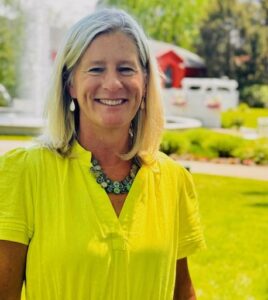
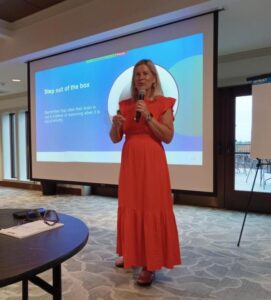
Barb Clark is a leading FASD trainer with over 15 years of expertise educating and supporting countless families and professionals. A mother of five young adults, Barb’s FASD journey began with her daughter’s diagnosis at age 6. With her children now in their 20s, Barb is not slowing down. A renewed jolt of passion hits with each look of recognition on the faces of the families and professionals she trains. About 7 or 8 years ago, Barb says, “there was this stage where I’m training on FASD and saying to myself, wait, this sounds like me.” Barb started to recognize in herself the core aspects of FASD that she would educate others about. The issues with attention, memory, and learning were hitting closer and closer to home. For the past few years, Barb has believed that she herself most likely is on the FASD spectrum. Just over a week ago, at a Florida clinic, a diagnosis made it official.
Barb’s very own diagnosis is the latest chapter in an incredible FASD journey. After her daughter’s diagnosis, Barb spent the next few years in what she calls, “that exploration stage, reading all the books, going to all the seminars.” She learned “the hard way” that traditional consequence-based parenting strategies were not effective. “I was parenting my daughter as if she were neurotypical, which doesn’t work with someone impacted with FASD in the way she is,” Barb explains. “By the way, those same strategies worked with me as a kid. FASD impacts me quite differently than my daughter, which shows that FASD is a wide spectrum.” Barb and her daughter share some of the same challenges, but they present as more subtle in Barb. In her daughter’s case, behavior issues were so significant that Barb had to learn a whole new way to parent, a process that led her to dive deep into the world of FASD.
As Barb was learning more about FASD, her interactions with the professionals that work with and support her daughter struck her. She saw that they did not truly understand her daughter because they did not understand FASD. Barb worked to help her daughter by educating her doctors about FASD. One pediatrician in particular impressed Barb, not with her expertise in FASD, but with her honesty in not knowing that much and an openness to learn more. This doctor gave Barb the opportunity to do her first FASD training, for a group of pediatricians at her daughter’s hospital. A month later, Barb was in a meeting when one of the doctors from that first training approached her with some news. Because of that training, he realized that his 26-year-old daughter has FASD. Barb was amazed. “Wow, here’s a prominent doctor who didn’t know his own child had FASD until a training, a brief training, connected the dots.” Her training had made a huge impact beyond her wildest expectations. Barb had found her calling.
Barb jumped in to the FASD field, first doing trainings for families with Proof Alliance in Minnesota. Currently a trainer at FASD Mosaic, Barb leads trainings for families and professionals involved in adoption, foster care, and kinship care. She trains on many topics like trauma, grief, and identity, though FASD remains her passion. “The story I share is how things started to go better for our daughter when we as parents changed, rather than us focusing on trying to fix our child.” You can request a custom training from the FASD Mosaic website.
“Each training I would do, I would recognize things in myself,” Barb says. “I’ve always struggled with math. I have ADHD big time, plus sensory struggles, issues with working memory, major sleep issues, and I’ve had this coordination thing where I can’t really curl the back of my hair or knit easily.” Those tasks involve “crossing the midline,” an important early developmental milestone for physically reaching across the middle of our body in a coordinated way. This requires both sides of the brain to communicate, and we know that this skill is specifically impacted by alcohol exposure.
Wishing to go in for diagnostics for years, Barb made an appointment with the diagnostic clinic at the Florida Center for Early Childhood just over a week ago. Since getting the diagnosis, Barb says, “I’ve already done two trainings and I shared my diagnosis in both of them.”
When people ask Barb why she sought out the diagnosis, she has no shortage of answers. For one, “There’s comfort and relief with just knowing the reason for struggles and challenges. I wanted to understand my own brain. I knew I struggled in certain areas, but actually seeing it in a diagnostic report is so helpful.” The diagnosis confirmed what Barb had long believed. “There are all these accommodations that I’ve instinctively made for myself in terms of setting reminders on my phone and so on. I shared my diagnosis with my colleagues at my employer Families Rising right away and they asked what accommodations they can make, which I appreciate so much and I told them, “Thank you, I’m going to put some real thought into that because there probably are some.”
Barb sees her own diagnosis and sharing about it as a way to destigmatize FASD and help people understand the spectrum. “For me to go out and say that I have FASD, even though it’s subtle, that demonstrates a few things. It illustrates the vastness of the spectrum. I hope it can destigmatize FASD and show that we can be successful and thrive, that we’re just like everyone else, and we don’t need to hide who we are, we can proudly show the world who we are. In my case, it’s a way to talk about the importance of protective factors when it comes to PAE. My mom had good nutrition, unlike my daughter’s biological mom, and that makes a difference.”
Barb addresses a common question she gets now that she has a diagnosis: Are you concerned about the blame and shame this could put on your mother? Barb responds, “My mom, who died 20 years ago, I think if she was alive, she’d support me sharing my diagnosis. My mom was a pioneer in the women’s rights movements, a real social change agent. She was an amazing woman and didn’t do this intentionally. No mother does this intentionally. I was born in the 1960s before FASD, or FAS at first, was identified in 1973 in the U.S. This is not about blaming, this is about recognizing and embracing our true selves.”
Going through with diagnosis proved to be quite a process for Barb, who notes the anxiety she felt. Before the appointment, a friend asked her, “How would you feel if you’re NOT diagnosed with an FASD, is that going to be a letdown?” Barb was prepared to accept that because she knows how complicated diagnosis can be. “For me, I was prepared to not get a diagnosis and I was relieved when I did get it.” To Barb, the diagnosis revealed a series of strengths that she sees in herself and others with FASD: a fun spirit, sense of humor, a gift at connecting to all sorts of people right away, never meeting a stranger.
“The whole testing process was fascinating to sit through and then read the results,” Barb says. “I felt like ‘oh yea, that tracks, that makes sense.’ My poorest test was an attention test, where I was all over the place feeling distracted, which tracks with my ADHD.” Barb scored highly in non-verbal reasoning, things like puzzles, and was told that usually people with high scores in that arena also score high in math and science, which she has always struggled in.
This discrepancy itself is a good illustration of a common FASD phenomenon backed up by research: divergent skills in areas that are traditionally linked. In her work with families, Barb sees this issue come up all the time in school settings. Teachers will see a student performing well in one area and assume they also perform well in a different, traditionally linked area. When the student performs poorly in this other area, this is often regarded as willful or not making the effort. Helping families navigate through challenges like this is what Barb finds so rewarding with her work and is what pushed her to seek out a diagnosis.
Even with all the testing, to get an FASD diagnosis, Barb needed to tell the doctors about the alcohol she was exposed to. Barb remembers that growing up, both her parents were frequent social drinkers. She even talked to her mom directly about her drinking during pregnancy. “We were both very open with each other,” Barb says. Barb remembers when she first told her mom about her daughter’s FASD diagnosis, the response was, “Well, I drank when I was pregnant with you and you’re fine.”
Barb recognizes her mom as being a product of her time and the context of what was understood, and she’s not alone. Barb hears this same response all the time during her trainings. One of Barb’s priorities is to raise awareness and to reduce the stigma around FASD, working with adoptive parents to not get stuck in a place of anger towards the biological parents of their kids and to work through this as a stage of grief, moving towards acceptance. “When people say things about my daughter like, “Can you believe her birth mom would do this” I correct them and say, “Look, I have nothing but love and respect for her mom and I know she had her struggles and this was not intentional.”
Barb values her diagnosis so much and is filled with gratitude, keenly aware that this opportunity is out of reach for so many, given the lack of diagnostic capacity across much of the country. She recognizes that her diagnosis was only possible because she had the opportunity to access a clinic with staff specifically trained in FASD. “When I got to the clinic, I told the doctor that I want to see if I may be on the FASD spectrum and that I also want to understand my brain better.” The clinic staff at the Florida Center is FASD-informed and Barb knows that if she had gone to a typical clinic, it would be very unlikely that she would ever have gotten a diagnosis related to FASD, even with the same test results and the same description of her mom’s drinking. “There are so many people impacted by PAE out there, who do in fact have FASD, that are not diagnosed and will not ever be diagnosed and recognized for having this,” Barb says. “I want to use my story to advocate for expanding access to diagnosis and services.”
Barb is the author of a new book, Raising Kids and Teens with FASD, that will be published October 21. “After I got my diagnosis, I reached out to the publisher to update it with my diagnosis,” Barb says. “I want to share this far and wide. My intention is to talk about my diagnosis in each training I do from now on, in part to destigmatize FASD and also so people understand how vast the spectrum is, and to show that people can be successful with the right accommodations.”
The highlight of Barb’s diagnosis journey has perhaps been her experiences sharing the news with her friends and family. “My daughter was so thrilled when I told her. Before that, I’d shared with her that I thought I may have FASD. When I broke the news that I had an official diagnosis, she was so excited that I was joining her. It has brought us even closer together.”
Each one of the self-advocates that Barb is friends with expressed such excitement at the news. “They all congratulated me and welcomed me in, and that feels great. I wish more people had that reaction. Some people don’t quite know how to respond when they hear it, but I tell everyone that I feel good about the diagnosis, I’m not upset by it, I know how helpful and empowering this diagnosis is.”
“I think me speaking out about having FASD can prevent exposure. If people understand that the level of alcohol I was exposed to impacted me, in subtle yet important ways, hopefully people will better understand that there truly is no safe level of alcohol during pregnancy,” Barb says. “And I know that if my mom was alive, she would be so supportive of me and what I am doing in sharing my story and training families.”
One message that Barb hopes people will take away from her story is to find their people, find your community. “Now that I have my diagnosis, I just want to join the FASD community, the community of advocates. It’s so helpful to talk with others who get this and to feel connected,” Barb says. “I’m joining a really awesome group of people who have this diagnosis. Not only my daughter but the families I work with, the self-advocates I am friends with. So many of the people in the FASD community are just amazing people. I’m so proud to be one of them.”