Dr. Petrenko is a leading FASD researcher who is developing innovative mobile apps to support people with FASD and their families. Working with CIFASD for almost 10 years, Christie’s career is dedicated to making the research deliver meaningful positive impacts for people with FASD.
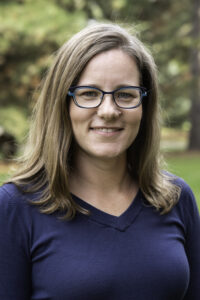
Dr. Christie Petrenko’s enthusiasm and support for CIFASD (the Collaborative Initiative on FASD) goes back to the very beginning. Dr. Petrenko reflects that in 2003, the very year that CIFASD started, “I was a brand new graduate student and excited to help out any way I could, whether that was assisting with data entry projects, or even getting coffee and lunches for researchers, I just threw myself in.” Over twenty years later, Dr. Petrenko reflects on her career so far, which has focused on advancing FASD research in ways that deliver meaningful outcomes to people with FASD and their families as they navigate the challenges that can come with FASD. “It has been amazing to see CIFASD in action, from those early beginning days all the way through now,” Christie says.
Dr. Christie Petrenko is a Research Associate Professor at Mt. Hope Family Center with appointments in the Departments of Psychology and Pediatrics at the University of Rochester. As she established her own lab at the University of Rochester, Christie had the opportunity to join CIFASD as a lead investigator. CIFASD is a project of NIAAA (National Institute on Alcohol Abuse and Alcoholism) that is designed to bring researchers from different specialties who work on FASD together to work in collaboration.
A clinical psychologist and researcher, it strikes Christie as serendipitous that the past two decades she has spent in the heart of the FASD field lines right up with the lifespan of CIFASD. The work is about more than just publishing the latest science. As Dr. Petrenko puts it, “My work within CIFASD is really focused on increasing access to care for people with FASD across the lifespan and across systems of care.” In addition to her research and work with CIFASD, Dr. Petrenko is a proud member of the FASD United Board of Directors.
Christie recalls the first three cycles of CIFASD were largely “multi-site,” where multiple research sites collect the same data from participants. “This was momentous for the field of FASD, because up to that point, most research was site-specific. The sophistication of the research was limited by its sample size and there was a need for more complex statistical analysis with expanded study designs.” Christie considers one of the biggest strengths of CIFASD to be the way it “empowers researchers to ask more sophisticated questions, because we can go broader in scale. CIFASD opened the door for researchers like myself to ask that next stage of questions that the field was ready for.”
Having different sites working together, including San Diego State University, University of Minnesota, and Emory University, as well as international university partners, “gave researchers the ability to combine data across fields, looking at dysmorphology, brain imaging. And neuropsychology, as well as consider other specialties like 3D imaging,” Christie explains. That moment when all this data first came together hit her with a wave of excitement. “Looking at these areas together in the same analysis was really interesting and created so much new information and understanding that really advanced the FASD field.”
CIFASD is funded by NIAAA as a consortium of investigators and projects, bringing top experts together to answer complex questions. “There’s a really engaging exchange of ideas and problem-solving within CIFASD,” Christie says. “Rather than being in my own silo doing my own study, CIFASD creates this synergy and sharing of ideas that I would miss out on if, as a researcher, I was doing my own projects separately.” It’s the collaborative spirit of CIFASD, and the resource sharing that goes with it, that is so powerful to Dr. Petrenko and the researchers she works with.
The unique structure of CIFASD allows for a tremendous amount of resource sharing. “I’ve benefitted from other programs within CIFASD referring participants to my studies,” Christie says. “There are also sites that collect things like 3D facial images or blood samples. Other groups can combine this information in their studies to answer important questions. As I’ve gotten to know the researchers on these projects, we are able to make linkages and share information that empowers and grows the impact of all our resources.”
Reflecting back on her career so far, Dr. Petrenko sees that, “I benefited so much from my mentors and advisors being in CIFASD throughout my career. Dr. Ed Riley, head of CIFASD, was my primary advisor. It’s been wonderful collaborating with so many others along the way, including Sarah Mattson and Jennifer Thomas, who I shared a lab with in San Diego.” In the beginning, Christie would find herself “fan-girl’ing out” as a young graduate student. “I was meeting all these researchers I had read about in papers. It was so cool, just seeing them in action and saying, ‘Oh wow, they’re amazing!’ and then getting the opportunity to work with them as close colleagues and mentors.”
Dr. Petrenko is passionate about FASD awareness and support and finds the field to be “relatively small but extremely nurturing and supportive” with many of the people in CIFASD serving as touchstones throughout her career. “For example, I got to work with Dr. Jeff Wozniak during my last year of internship training for my PhD. Claire Coles, Mary O’Connor, and Heather Carmichael Olson offered to be consultants on my career development award and were very generous in shaping my thinking on developing interventions. I’ve had the joy of collaborating with many folks through CIFASD.”
Christie feels that she couldn’t imagine a more supportive group to come up in during her career than CIFASD. “That collaboration that I observed as a grad student all the way to now, mid-career, shaped much of my other research as well. Now I think a lot about team science and the joy of doing things together and enriching what we’re working on, as opposed to being on my own.”
Dr. Petrenko discussed two major CIFASD projects that are delivering results for people with FASD and their families. Both of these projects have been co-led with her collaborator Cristiano Tapparello from the University of Rochester’s Health Lab and Department of Electrical and Computer Engineering. The first project is extending the inspiring work of Heather Carmichael Olson and her colleagues from Seattle Children’s Research Center and University of Washington on the Families Moving Forward Program to increase access to care. This has included creating a self-directed app for caregivers called Families Moving Forward (FMF) Connect from 2017-2022, and now a new program for mental health providers called Families Moving Forward (FMF) Connect Pro. This work also inspired her team to develop the My Health Coach app for adults with FASD. My Health Coach “provides resources, tools, and information to improve physical health and quality of life for adults with FASD or known prenatal alcohol exposure.”
FMF Connect Pro is really working to help the mental health field be more FASD-informed. When it comes to FASD and mental health, the need is great. “We know that about 15-20 percent of children receiving a mental health service have an FASD, yet most are undiagnosed,” Christie says. “The mental health field hasn’t had much opportunity to learn about FASD and the topic is not in their education programs. Most providers report not feeling confidant serving the population of people with FASD.” Setting out to address this issue and make a difference, Christie and her team developed FMF Connect Pro. “It’s aimed at teaching mental health providers three main things. First, how to do routine screening of PAE with all their clients. Second, how to use the diagnostic criteria in DSM-5 when there is PAE identified, and third, how to adapt treatment and use the FMF Connect app with with families.”
FMF Connect Pro is training mental health providers in how to work with people with FASD. As Christie explains, “We’re testing two different training methods in our study. The first approach, using Zoom, involves providers coming together twice a month for six months. We teach them about FASD, how to do screening and diagnosis, and how to support families. We also use case-based learning to apply this new information. Our second training approach gives all the same information on a website that providers can use at their own pace.” Through this training, Dr. Petrenko and her team are educating a broad swath of providers of children in different mental health settings about FASD. “We want to increase identification of supports for families in their communities.”
CIFASD is a crucial tool for studying the impact of FMF Connect Pro across six states and regions. “We’ve selected states that have investigators from CIFASD who can help identify providers and agencies in their state so we can efficiently target a wide range of people and expand knowledge,” Christie says. “For example, we’re currently recruiting in Washington. I’m asking CIFASD researchers to make linkages and they are connecting us with providers and systems of care, as well as training programs that they know well.” Dr. Petrenko acknowledges that these networking connections form a key foundation for her research, which “would be very difficult to do outside of CIFASD.” Dr. Petrenko recently opened up enrollment across the US to complement the targeted enrollment. Interested providers can get more information online.
Dr. Petrenko’s My Health Coach app is strongly influenced by the work of CIFASD. As Christie points out, “Most of what we know about FASD is from children. We have little knowledge of what that looks like in adults. In CIFASD, researchers initiated a study looking at adult health outcomes. On our CIFASD calls, it was fascinating to hear the results come in.” Christie was fascinated to see the research on physical health outcomes in adults with FASD, which lined up with what she had been hearing from adult self-advocates that spoke with her and CIFASD colleagues. “This research on adults inspired us to come up with a set of tools for getting this information to people with FASD,” Christie says. “I found myself asking, How do we get people with FASD the tools so they can more easily navigate the health system and communicate their symptoms with providers?”
Drawing on the knowledge gleaned from her team’s work with the FMF Connect app, Christie and Cristiano worked to develop an app for adults. “We were able to realize this vision we had within CIFASD through community engaged research. We partnered with an incredible group of self-advocates, the Adult Leadership Collaborative (ALC) of FASD Changemakers, to ensure we are following the ethos of “nothing about us without us.” We knew we could learn from their living experience and co-create something that would be useful for people with FASD and the FASD community.”
Christie lights up as she talks about her experience working with people from the ALC, meeting every month to go over ideas. “We did focus groups and surveys and supported the changemakers collecting data from their peers. Then we had our initial trial to see how people would use the app on their own phones.” Drs. Petrenko and Tapparello recently launched a much larger study to test how the app is making an impact for adults with FASD. “We were able to do initial testing and see that the people could use the app on their phones in a wide variety of ways. That helped us make it better.”
The next stage, as Christie describes it, is to see how the My Health Coach app relates directly to outcomes, how it can help people. “I’m so excited to see how that goes,” Christie says. To learn more, sign up here. You can view a 2-minute video explaining the study and reach out by email for more information at [email protected].
The collaboration with the self-advocates in ALC is a real highlight of Christie’s work, especially the opportunity to co-present with ALC members. “This is how research can come together. In addition to generating important science for our publications, it’s something that’s practical and meets the needs and preferences of people who use it.” Christie spoke about her love for doing research that has a practical impact. “I love when I can combine the research and quality science and also things that are purposeful and meet the needs of the community,” Christie says.
CIFASD is so valuable to both of these projects when it comes to recruitment. “We get a lot of referrals through CIFASD,” Christie says. “We were able to pull the knowledge from the adult health study in CIFASD and translate that into materials for people to find useful.” Christie is proud of her own work’s contribution to CIFASD and how it can serve as a model for community engaged research for other projects. Dr. Petrenko’s projects have provided a major opportunity for ALC members and self-advocates to engage further with CIFASD and share their ideas with researchers. “This has shifted the FASD field’s awareness that this is not a pediatric condition but is across the lifespan. That’s been a contribution we’ve been able to make,” Christie adds.
As Christie’s career has progressed and closely tracked along with the development of CIFASD, she notes that at this stage, “It’s been really amazing to also support emerging researchers coming up behind me. It’s so fun meet and collaborate with the next group coming up.” Christie spoke about Tammy Bodnar, one of the newer investigators in CIFASD. “I first met her in Japan in 2018 as she was finishing her post-doc and presenting in a symposium. We’re now supporting each other’s studies. We’re both working with adults. She is a great colleague to work with.” As a professor, Dr. Petrenko loves the opportunity to give back, to work with students and give to others the benefit of the nurturing that she had. “It’s great seeing my students experience the joy of collaborating with the people in CIFASD. It creates this network of folks who can offer support and that I can support as well.”
Reflecting on her personal highlights over her years with CIFASD, Christie says, “I have all these fond memories of past in-person meetings that have this strong sense of comradery. Some of the most fruitful experiences have been the moments of personal connection, whether that’s having a meal or touring historic sites as we explore cities that host our conferences and meetings, having the connections as people, it strengthens or professional collaborations, and it brings a joy to our work.”
One moment that stands out for Christie was during an FASD study group meeting. Christie was co-presenting with a member of the ALC changemakers. “I started getting text messages from an ALC member about the research that was being presented. It was really cool to see the questions they had and to see how I could respond to those and put them in context. The questions were fascinating and touched on areas that I hadn’t even thought of before.”
“It was a real honor to join CIFASD, given my roots as an observer, and then to become a member,” Christie explains. “The supportive environment of CIFASD gives me a boost of confidence to try things a little outside the box and be creative and feel supported by a scientific community. I’ve appreciated the openness and interest within CIFASD to engage in the broader FASD community, including self-advocates and families, as well as policy advocates.”
Meetings that include self-advocates along with her university team are “the most fun science I’ve ever done,” Christie says. “We all have the most fun creative brainstorming sessions. It’s this great exchange where someone will have an idea and then we’ll mock something up during the meeting and there’s this great feedback. There’s so much excitement, just a lot of fun, someone will often make a joke, and it’s hilarious and productive at the same time. It’s such a lovely experience and CIFASD is what makes this process possible.”